The Blue Glow Revenue Stream: Why Your Mobile Strategy is a Profit Leak
April 20, 2026 | Read Time 6 minutes
Most 4 and 5-star GMs are sitting on a goldmine they haven’t yet discovered. We’ve spent the last decade obsessed with digitizing the guest journey, yet in 2026, the average luxury property still treats tablets and mobile apps like a glorified digital brochure.
If your guest is flipping through a paper menu, scanning a QR code to order from a PDF menu or, worse, picking up a plastic landline to order a $200 bottle of Barolo, you aren’t providing modern “white glove service.” You’re leaving high-margin revenue on the table.
In the 2026 hospitality landscape, guestroom tablets and smartphones aren’t a distraction; they are the most efficient sales associate you will ever hire. Here is how elite independent and luxury flags are turning modern digital media merchandising into a RevPAR powerhouse.
The Death of Passive Hospitality
For years, the industry’s approach to digital was defensive: “We need an app because everyone else has one.” Smart hoteliers with scale have found mobile to be a central component of their CRM strategy, but this level of sophistication is out of reach of the vast majority of hotels, who find it difficult to compete with the major global brands. This leads to “App Fatigue”, single-use apps with clunky web-first interfaces that guests downloaded at check-in and deleted by the time they got to the elevator.
The shift we are seeing today is Anticipatory Merchandising. It moves away from the “if they want it, they’ll ask” mentality and toward a data-driven “it’s already waiting for you” model.
Contextual Upselling: Beyond the Room Upgrade
Traditional upselling is a pre-arrival email asking a guest to pay $50 more for a view. Digital-first merchandising in 2026 is far more precise and targeted.
By integrating your PMS (Property Management System) and Loyalty Program CRM with tablets that can deliver messaging based on real-time guest behavior, you can trigger micro-moments of conversion, enabling a mobile-first strategy.
Tablet engagement drives mobile conversion: by leveraging guest room tablets as an integrated driver of conversion to your mobile app, you launch a truly luxurious guest experience that sets your brand apart during their current and future stays. Our experience shows up to 95% of food and beverage orders are handled by guest room tablets once they are installed, with the average order size increasing 22% higher than offline orders. Integrating room controls, such as lighting fixtures and thermostat, give guests the total control they desire and optimize their comfort. And integrating the tablet with your mobile app gives guests the perfect reason to want to stay with you next time, which opens up a world of revenue potential:
- The Arrival Surge: A push notification sent 20 minutes before a guest’s Uber arrives from the airport: “Your favorite chilled Chardonnay is available for your arrival. Tap to have it waiting in-room.” A welcome message on the guestroom tablet to the guest indicating a reservation at the hotel’s sushi restaurant is waiting for them, letting them know you paid attention to their preferences from their last visit.
- The Spa Gap-Fill: It’s 1:00 PM on a Tuesday. You have two empty treatment rooms. A targeted notification to guests currently on the property via their guestroom tablet, excluding those at a known business conference, can recover thousands in perishability loss.
- The Hottest Ticket in Town: Integrating ticketing platforms for shows, attractions, and experiences allows hotels to deliver meaningful moments that transform the guest’s stay into a memory they’ll cherish for a lifetime. And marketing access to those events via tablet and mobile gives the guest the incentive to splurge on a high-value experience that turns the mundane business trip into a sublime occasion, with incremental revenues earned by the hotel via the sale.
The Total RevPAR (TRevPAR) Engine
The 5-star experience is no longer just about the room. When you move merchandising to a central hub, be it an in-room tablet the guest’s own device, you remove the friction of embarrassment. HCN sales data from Q4 2025 suggests that guests will spend 22% more on F&B and ancillaries when ordering via a guest room tablet compared to verbal or paper-based methods. Why? Because a high-resolution photo of a signature cocktail or a video of a sizzling ribeye steak is more powerful marketing than a line of text on a card.
High-Intent Merchandising Tactics for 2026
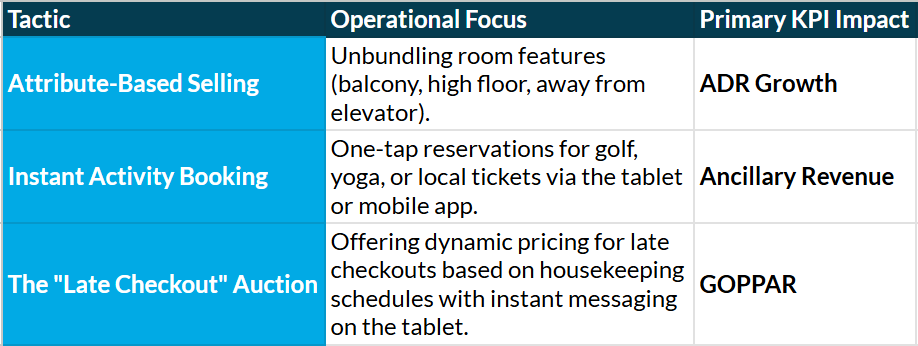
The “Quiet Luxury” Filter: Witty, Not Gritty
A common fear among luxury Directors is that mobile merchandising feels cheap or “salesy.” This is a fundamental misunderstanding of the modern luxury traveler.
True luxury in 2026 is the absence of friction. The guest doesn’t want to be marketed to. They want to be curated for. This is where your CDP (Customer Data Platform) becomes your best friend. If a guest has stayed at your property three times and never visited the gym, but always orders a late-night club sandwich, your tablet or mobile content should stop pushing “Morning Boot Camp” and start featuring “Executive Midnight Snacks.”
Is Your Stack Actually Ready?
Before you chase the mobile-first dream, you need to ask the hard questions:
- Is your PMS/POS integration Real-Time? Nothing kills guest satisfaction faster than a guest ordering a 2:00 PM massage that was actually booked ten minutes ago via the front desk.
- Is the payment friction-less? If the guest has to re-enter credit card details into their phone while sitting in your lobby, you’ve already lost the sale. Apple Pay and Google Pay are no longer optional, they’re the standard.
“A tablet or mobile app that doesn’t talk to your POS in real-time isn’t a tool; it’s a liability.” – Neil Schubert, Chief Product Officer, HCN, and former VP Guestroom Technology for Marriott Hotels.
Moving the Needle
The transition from a service-led model to a digital-first merchandising model is not about replacing staff, it’s about freeing your staff to perform high-value emotional labor while the technology eliminates the transactional friction.
By capturing the guest’s attention on the screen they are already staring at, you don’t just improve your guest engagement and satisfaction. You own the entire guest narrative from the moment they land to the moment they check out.